Table of Contents
Major New Features & Highlights
GAMS Studio
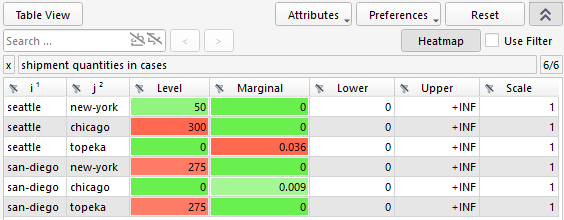
Heatmap in the GDX Viewer
The GDX Viewer can now display numerical data as a heatmap. Each cell is colored according to its value, which makes it easy to spot patterns, clusters, and outliers at a glance. The heatmap is switched on and off with a button in the control header and works in both the List View and the Table View.
Each attribute uses its own minimum and maximum for the color scale. With the checkbox Use filter, the minimum and maximum are taken either from the filtered data only or from all data of the symbol. Attributes with the same value in all records aren't highlighted.
In the Table View, usually only one Attribute is highlighted. Additional attributes can be switched on and off with Ctrl+Click (Command+Click on macOS).
Code Snippets
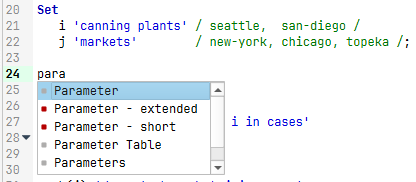
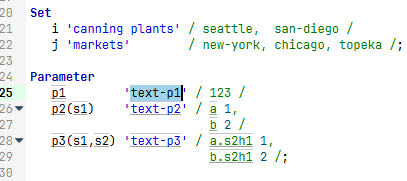
GAMS Studio now supports code snippets: reusable pieces of GAMS code that are offered by the code completer. They appear automatically while typing, or on demand with Ctrl+Space. After inserting a snippet, use Tab to jump between its placeholders and fill them in one after another.
One can also define own snippets via the menu Tools > User Snippets.
GAMS Engine Multi-Login
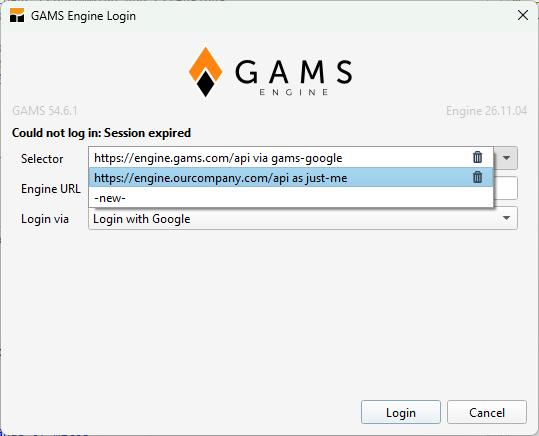
GAMS Studio can now store multiple GAMS Engine logins, which is useful when working with several Engine servers or with different accounts. Each login gets a name that combines the server URL, the login method, and the user name or the SSO service, e.g. Google. This makes it easy to tell the logins apart and to switch between them.
GAMS System
Performance Boosts for Model Generation
GAMS 36 introduced an under-the-hood optimization that significantly speeds up model generation for equations where the index order causes variables to be referenced out of order. However, this feature was historically triggered quite conservatively.
With this release, the internal triggering logic has been fine-tuned, so that this performance boost is available automatically in far more scenarios.
Affected Models
Models that use subsets or complex mappings to limit the number of active variable records should see a noticeable drop in generation time. A classic example of this pattern is when dense multidimensional variables are restricted by smaller, sparse index sets:
Set d domain set / 1*10000 /
    i(d)         / 1*200 /
    j(d)         / 1*200 /
    k(d)         / 1*200 /;
Variable z, x(d,d,d);
...
* The index order in the equation causes out-of-order referencing in x(i,j,k)
ekj(k,j)..  sum(i, x(i,j,k)) =e= 42;
Out-of-the-Box Optimization
No changes to the model are required to benefit from this update; the smarter tracking is active by default. For users who need to maintain strict backward compatibility with older versions for regression testing, the command-line parameter sys19 has been extended to allow to opt out of this optimization. This may also be useful if the new default causes problems. In that case, please contact support@gams.com.
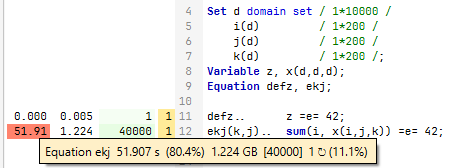
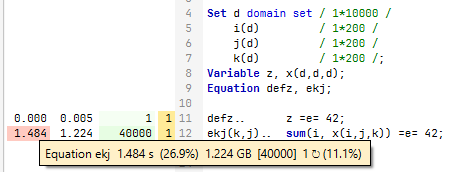
The following shows the speedup when comparing the new default (sys19=0) and the backward compatibility mode (sys19=2) using the Studio Profiler:
Solvers
BARON
BARON 26.11.15 introduces deterministic termination based on work-units, a link to HiGHS as LP/MIP/QP subsolver, and new bound tightening and dual bounding modules. It also includes extensive work on the numerical robustness of BARON's reduction, relaxation, and LP solution routines.
Gurobi
Gurobi 14.0.0 introduces a PDHG-based MIP heuristic (see pdhgmipheurtime), a NoRel heuristic during tree search (see noreltreeheur), and outer approximation cuts for MIQP, MIQCP, and MINLP models (see oacuts). For LPs solved with PDHG, crossover now runs concurrently by default (see pdhgearlycrossover).
HiGHS
The MIP solver of HiGHS can now exploit the branch-and-bound tree in parallel, use Fourier-Motzkin elimination in presolve, and generate cutting planes for models that contain single machine scheduling subproblems.
The interior point solver HiPO now parallelizes more solve steps and can use a simplified factorization for very sparse problems.
The GAMS link to HiGHS has been completely rewritten and uses the same modern interface library as the links to FICO Xpress and Gurobi.
Knitro
KNITRO 16.0.0 introduced a new concurrent solver to run multiple algorithm configurations in parallel. This increases robustness and speed of the solver by returning the first optimal solution found. By default, the concurrent solver uses a single algorithm with various tunings, but can be configured to run different algorithms simultaneously. To enable this feature, set the concurrent_solver option to 1. The default setting of -1 lets Knitro automatically decide whether to use this feature based on the problem characteristics.
SHOT
SHOT 2.0.0 provides much improved performance for both convex quadratic and nonconvex problems. Further, HiGHS can now be used as MIP subsolver and a direct interface for using CONOPT as NLP solver is now available.
Xpress
Xpress 48.01.01 introduces several performance enhancements. The primal-dual hybrid gradient (PDHG) algorithm is now out of beta (see barAlg) and is accompanied by a first MIP primal heuristic running on GPUs (see heurBeforeLPGPUMethod). Xpress now supports running heuristics in parallel with the root LP relaxation of a MIP search to find feasible solutions faster (see lpBackgroundThreads). New path mixing cuts have been added to better handle problems with mixed integer path structures (see cutSepPathMixStrategy). The MIP solution pool has been reworked and is now based on the new solution pool of Xpress (see MIP Solution Pool). Furthermore, branching strategies and the separation of various cuts have been improved. Cut separation, heuristics, presolve, and scaling can now be controlled by new, more fine-grained options.
APIs
The .NET API has been modernized: a new GAMS.net10.dll, built for .NET 10, now runs natively on all supported platforms. Example projects use the modern SDK-style project format, and the on-disk file structure has been revised.
Breaking Changes
Platforms
- Dropped support for macOS 14.
GAMS System
- In the past, unmatched tags for
$else,$elseIf, or$endIfwere silently ignored if they were located in a section being skipped. This is now reported as an error, and models that relied on such unmatched tags in skipped sections need to be corrected (see details). - $declareAndLoad now loads equations with an unrecognized type as
=n=instead of=e=. Models that load such equations, e.g., from GDX files written by third-party tools, may now contain different default values than before (see details).
Documentation
- Removed documentation of test library.
Solvers
- BARON: Removed capability to use FICO Xpress as LP/MIP/QP subsolver. Removed option
AllowXpressand value 7 for option LpSol. - CONVERT: The CplexLP, CplexMPS, and FixedMPS formats now write an objective function instead of an objective variable by default. Set option Reform to 0 to get the previous output.
- CPLEX: If CPLEX returns status "Solution satisfies tolerances" (102) and the solution check finds violations, the model status is no longer changed to infeasible; only a warning is displayed. Use option solcheck 2 to get an intermediate infeasible model status instead.
- CPLEX, GUROBI, ODHCPLEX, and XPRESS: Dot options now require quoted labels or
*in the domain, e.g.,x.prior('i1',*) 3. Lines with unquoted labels, e.g.,x.prior(i1) 3, are now ignored with an error. - GUROBI: The parameter tuning tool now writes the baseline to
gurobi.100and the best parameter set found togurobi.101. Before, the file numbers depended on the number of results, e.g., withtuneresults 2, the best parameter set was written togurobi.o99. Optiontuningis deprecated; use options tune, readparams, and tuneproblems instead. - HiGHS: Hitting the memory limit now results in solve status 4
TERMINATED BY SOLVERinstead of 3RESOURCE INTERRUPT, and IIS information is written to the log file only. Optionssimplex_initial_condition_checkandsimplex_initial_condition_tolerancehave been removed. - KNITRO: Options
scale_vars,mip_maxsolves,ma_outsub,ma_sub_maxtime, andma_terminatehave been removed. - SHOT: Replaced options
Model.Reformulation.ObjectiveFunction.Epigraph.Use,Model.Reformulation.Quadratics.EigenValueDecomposition.{Use,Method},Dual.ESH.Rootsearch.UniqueConstraints. Removed optionsDual.HyperplaneCuts.SaveHyperplanePoints,Subsolver.Gurobi.PoolSolution,Model.Reformulation.Quadratics.EigenValueDecomposition.Formulation,Model.Reformulation.Quadratics.EigenValueDecomposition.Tolerance. - XPRESS: Options that are deprecated in Xpress 48.01 have been removed in favor of their replacements, e.g., the options for cut separation, heuristics, presolve, and scaling (see details for the complete list). Options
cacheSize,l1Cache,maxTime,sleepOnThreadWait, andsymSelecthave been removed. The solution pool now uses the solution pool built into Xpress, which replaces optionssolnpoolCapacity,solnpoolCullDiversity,solnpoolCullObj,solnpoolCullRounds,solnpoolDupPolicy,solnpoolPop, andsolnpoolVerbosityby new options, e.g., poolLimit and poolEnumStrategy. The former solution pool and enumerator remain available with the hidden solverXPRESSOLD. Knitro optionsknitro_algorithmandknitro_mip_rootalghave been renamed toknitro_nlp_algorithmandknitro_mip_root_nlpalg, andknitro_mip_lpalghas been removed.
APIs
- .NET:
- The public method
Compact()ofGAMSDatabasehas been removed in the .NET 10 version. - The C++/CLI (CPPnet) examples have been removed, along with the corresponding
CPPtrseqAPI library model. C# examples have been moved fromapifiles/CSharptoapi/dotnet/examples/{control,core}/csharp. VB.NET examples have been moved fromapifiles/VBnettoapi/dotnet/examples/{control,core}/vb. - On Windows, the .NET 10 version now checks the
PATHenvironment variable before the registry to find a GAMS system. - Removed
GAMS.net4.chm. - Precompiled executables of the GUI examples are no longer distributed.
- The public method
- Python:
- As announced, the
gams.engineAPI has been dropped. - On Windows, GamsWorkspace now checks the
PATHenvironment variable before the Windows registry when determining the GAMS system directory automatically. This may select a different GAMS system than before; specify the system directory explicitly to avoid this.
- As announced, the
55.0.0 Beta release (November 18, 2026)
Acknowledgments
We would like to thank all of our users who have reported problems and made suggestions for improving this release. In particular, we thank Marcel Adenauer, David Bernal Neira, Geoffrey Blanford, Wolfgang Britz, Rob Davies, Michael Ferris, Katja Jensen, Carolin Kellenbrink, Evangelos Panos, Anne Sofie Skak-Iversen, and Manuel Wetzel.
Platforms
- Dropped support for macOS 14.
- We plan to drop support for macOS on x86_64 (Intel) CPUs in 2027.
GAMS System
GAMS
- Tuned the automatic trigger for the out-of-order variable index optimization (introduced in GAMS 36). The performance boost is now activated much more aggressively, particularly when subsets or mappings significantly restrict variable records relative to their full domain. This optimization is enabled by default; use command-line parameter sys19 to revert to the legacy behavior.
- Improved performance of GAMSPy for models with many equations: the time needed to execute a statement no longer grows with the number of equations defined earlier in the same session, unless equations get redefined.
- Added model attributes absGap and relGap to allow programmatic access to the absolute and relative optimality gaps achieved by the solver.
- PreviousWork now writes a workfile compatible with GAMS 54 and newer.
- $declareAndLoad: Adjusted the fallback behavior when loading equations with unrecognized symbol types (e.g., from third-party generated GDX files). The compiler now defaults these symbols to
=n=instead of=e=. - The solution listing written for asynchronous solves (solveLink 3 and 6) with AsyncSolLst set to 1 now has the same layout as the one of a synchronous solve. In particular, values are no longer rounded to three decimals, which displayed small values like a bound of 1e-4 as zero. Also, the listing file no longer contains a NUL character after the report summary.
- Equation-variable pairs (e.g.
e.x) in a model statement are now ignored for model types that do not use matching information (e.g. LP, NLP, or CNS). Previously, an empty equation paired with a variable that is not fixed resulted in the errorMCP pair ... has empty equation but associated variable is NOT fixedfor these model types, and an infeasible empty equation paired with a variable was dropped silently instead of being reported. Such a model now behaves exactly like the same model without pairs. - Fixed a problem where a
$else,$elseIf, or$endIfwhose tag did not match the enclosing $ifThen was silently ignored if it was located in a section being skipped. This is now reported as error 676, as it already was in sections being processed, including for $ifThen blocks nested inside skipped sections. - Fixed a bug when executed as GAMSPy backend where a save file written after an earlier save in the same session (e.g., by calling
gp.serializetwice) could be corrupt if equations were redefined in between, causing an internal error after restarting from it.
GAMS Connect
- With pandas 3.1 or newer (as shipped with GMSPython), the CSVReader reads floating-point numbers exactly. Therefore, values read by the CSVReader may differ from earlier GAMS versions in the last digits.
GMSPython
- Python has been upgraded to version 3.12.16.
- We plan to upgrade the Python version of GMSPython from 3.12 to a more recent version in a future GAMS release. This may affect custom embedded Python code.
Documentation
- Replaced references to test library models by code snippets or links to other parts of the documentation or the GAMS model library.
- Example code for external equations and extrinsic functions is now part of the documentation (docs/examples directory).
- Removed documentation of test library.
Installer and Download
- The Windows and macOS installers now introduce GAMSPy, GAMS MIRO, and GAMS Engine on the installation progress/conclusion page.
- The MD5 hashes will be removed from the download page. Please use the SHA256 hashes instead.
Solvers
ANTIGONE, CBC, HiGHS, Ipopt, SCIP, SHOT
- New ARM performance libraries 26.07, now using the multithreaded variant, on Linux/arm64.
- New Intel MKL libraries 26.2 on Linux/x86_64.
ANTIGONE
- Fixed that controlling the number of threads for linear algebra routines via the threads option was broken.
BARON
- New libraries 26.11.15.
- Introduced a new deterministic work-unit accounting.
- New option MaxWork to limit the number of work-units spent by BARON.
- Option DeltaTerm is now based on work-units rather than time.
- New option PrWorkFreq for periodic reporting of work-units to the log. Changed default for option PrTimeFreq to 0.
- Added possibility to use HiGHS as LP/MIP/QP subsolver (new value 16 for option LpSol and new option AllowHighs). When CPLEX is not licensed, BARON will now use HiGHS instead of CBC by default.
- Removed possibility to use FICO Xpress as LP/MIP/QP subsolver. Removed option
AllowXpressand value 7 for option LpSol. - Presolve improvements:
- Fourier-Motzkin elimination extended to linear columns that appear in nonlinear rows.
- Duplicate columns are detected and correctly postsolved.
- More effective substitution and bilinear aggregation.
- Improvements in convexity identification for conic constraints.
- Bound Tightening improvements:
- New family of safe bound tightening routines for squares, powers, monomials, and bilinears, replacing the previous relaxed forward reduction scheme.
- New routines to reduce 'missing bounds' cases.
- Reduced bound tightening time by using hand-unrolled kernels for the most common expression sizes.
- Relaxations:
- Pinned random seeds in BARON's subsolvers for deterministic behavior across runs.
- Ill-conditioned cuts for monomials are no longer generated.
- New handling of unsafe LPs, including cold-started node LPs, deactivation of advanced bases when warranted, and independent calculation of Farkas certificates.
- Improvements to cut generation for integer programs, including learning conflicts from infeasible nodes, enhanced cMIR and Gomory cuts, improved aggregation quality, and speed.
- New certified-ray facility to diagnose unbounded nonlinear problems whose unboundedness arises in the purely linear part, extending machinery that previously applied only to unbounded MILPs.
- New implementation for convex MIQPs, leading to speedups for box QPs and linearly constrained QPs.
- New evaluation of dense quadratic functions yields speedups for node-heavy MIQPs.
- Improved branching point selection to avoid branching too close to a variable bound.
- Speedups in strong branching.
- Improved signal handling, including blocking of repeated signals during final solution writing.
- Introduced a new deterministic work-unit accounting.
- More BARON options are now available via the GAMS/BARON link: PrimalCSTol, DualCSTol, DualFeasTol, ProblemIsConvex, and Target.
CONOPT
- Updated CONOPT and CONOPT3 to refactored option library for reading option files. Reading options may behave differently in some cases. Please contact support@gams.com if there is any issue. As an immediate workaround, the old option library is still available: Set the environment variable
GAMS_JOAT_OPT_OLDto a GAMS system path. If left empty or set to "1", the option library from the default GAMS system will be used. This backup will be removed in a future release.
CONVERT
- By default, the CplexLP, CplexMPS, and FixedMPS formats now generate models with an objective function instead of an objective variable. To revert to the behavior of using an objective variable, set the option Reform to 0.
CONVERT, CPLEX, GUROBI, KNITRO, MINOS, ODHCPLEX, SNOPT, and XPRESS
- Improved performance of reading option files.
- Values outside of the bounds of an option, values not allowed for an enumerated option, and values that are not numbers of the option type are now ignored with an error. Before, values outside of the bounds were moved to the nearest bound.
- Lines of an option file that cannot be read, e.g., unknown options, are now reported as errors, also with
echoturned off. Before, they were reported as warnings and only withechoturned on. - An option file that cannot be opened, e.g., a file given with
readfilethat does not exist, is now reported as an error. - Fixed quoted option values being cut at comment characters, e.g.,
workdir "my*dir"for CPLEX. - Fixed values of list options, e.g., tuning for CPLEX, being replaced instead of added when they are given in several option files read with
readfile. - Fixed values beyond the maximum number of values of a list option replacing the last value. Such lines are now ignored with an error.
- Fixed crash for option files that include themselves via
readfile.
COPT
- PDLP now obeys an iteration limit set via GAMS option iterlim.
CPLEX, GUROBI, ODHCPLEX, and XPRESS
- Dot options now require quoted labels or
*in the domain, e.g.,x.prior('i1',*) 3, as documented. Lines with unquoted labels, e.g.,x.prior(i1) 3, are now ignored with an error. - Fixed potential crash for dot options without option name or with empty labels, e.g.,
x. 3orx.prior(,'i1') 3. Such lines are now ignored with an error. - Fixed indicator mappings mixing quoted labels and unquoted indices, e.g.,
indic e1('i1',j)$b('i1',j) 1, being read wrongly. Since mixing both formats is not supported, such lines are now ignored with an error. - Fixed several indicator mappings for the same equation being passed to the solver. Only the first mapping is used now, the others are ignored with a warning.
CPLEX
- Added option solcheck to control the check of the solution returned by CPLEX for violations of variable bounds, constraints, and integrality restrictions. By default, a warning is displayed if violations are found. With
solcheck 2, the model status is changed to intermediate infeasible and infeasibility markers are set. - Renamed options
eprhscheckandepoptcheckto solcheckfeastol and solcheckopttol. The old names are still accepted as synonyms. - Added option solcheckinttol (default: value of epint) for the integrality tolerance of the solution check.
- Changed/Fixed mapping of CPLEX status "Solution satisfies tolerances" (102): The model status is no longer changed to infeasible if the solution check finds violations, but a warning is displayed (see solcheck). Fixed the computation of the integrality violation.
- Fixed the option file written by tuning containing options with synonyms several times.
GUROBI
- New libraries 14.0.0.
- New PDHG-based MIP heuristic, controlled by the new options pdhgmipheursolutions, pdhgmipheurtime, and pdhgmipheurwork.
- New option noreltreeheur: Controls the aggressiveness of the NoRel heuristic during tree search.
- New option oacuts: Outer approximation cut generation.
- New option pdhgearlycrossover: PDHG concurrent crossover start accuracy. Concurrent crossover for PDHG is enabled by default.
- New options nlbarinitmu and nlbarstartpush for the NL barrier algorithm.
- New value 7 (NL barrier) for option method and new value 4 (PDHG, dual, and primal simplex) for option concurrentmethod.
- Changed default of option nlbariterlimit from 1000 to 10000 and of option pdhggpu from 0 to -1 (automatic).
- Function constraints are deprecated. Options
funcmaxval,funcnonlinear,funcpieceerror,funcpiecelength,funcpieceratio, andfuncpiecesare deprecated accordingly.
- Nonlinear constraints and a nonlinear objective are now passed as Gurobi's new nonlinear constraints and nonlinear objective instead of the deprecated general nonlinear constraints, which Gurobi 14 no longer supports for local optimization (optimalitytarget 1).
- Added option solcheck to control the check of the solution returned by Gurobi for violations of variable bounds, constraints, and integrality restrictions. By default, a warning is displayed if violations are found. With
solcheck 2, the model status is changed to intermediate infeasible or intermediate non-integer and infeasibility markers are set. Before, violations of variable bounds and constraints larger than 1e-4 were always marked as infeasible. - Added options solcheckfeastol (default: value of feasibilitytol) and solcheckinttol (default: value of intfeastol) for the tolerances of the solution check.
- Removed option
dofuncpieces, which had no effect. - Option nodemethod now only accepts the values -1 to 2 documented by Gurobi.
- Added option nonlinearstart to pass the variable levels as starting point for models with nonlinear or quadratic terms. It is enabled by default.
- Changed the activation of the parameter tuning tool: New option tune activates the tool, and new option tuneproblems names problem files to tune instead of the model. Gurobi parameters to keep fixed during tuning are set as usual, e.g., via readparams. Option
tuning, which combined all of this in a single string, is deprecated. See Parameter Tuning. - Changed the option files written by the tuning tool: the baseline is written to
gurobi.100, the best parameter set found togurobi.101, and further parameter sets togurobi.102onwards. Before, the file numbers depended on the number of results. - Fixed tuning of problem files ignoring the tuning options, the Gurobi parameters to keep fixed, and the log output.
- Fixed options mipstart, varhint, and feasopt using invalid values for the auxiliary variables Gurobi adds for nonlinear constraints or a nonlinear objective.
- Fixed
x**cwith an integral non-negative constantcrestrictingxto positive values, because it was reformulated toexp(c*log(x)).
HiGHS
- New libraries 1.16.0.
- The MIP solver can now use multiple threads to explore the branch-and-bound tree. New option mip_search_simulate_concurrency.
- HiGHS now uses as many threads as there are CPU cores by default (threads=0).
- Presolve now distinguishes between an initial sweep, light rules, and a full mode. New option presolve_mode.
- New presolver using Fourier-Motzkin elimination. New option presolve_fm_obj_reformulation.
- Added aggregations for implied bounds (implications) and dual fixing within probing.
- New cutting planes for single machine scheduling subproblems.
- Faster handling of free variables and faster triangular solves in HiPO.
- HiPO can now parallelize the solve step for a factorized linear system and the construction of normal equations.
- Parallelization in HiPO can be customized with option hipo_parallel_type (default changed to new value
choose) and new options hipo_parallel_forbid and hipo_parallel_force. - HiPO can now use a simplified "uplooking" factorisation that works well when the matrix is very sparse. New option hipo_factor.
- IPX now terminates when its iterates stall or when a time limit is reached while forming the initial basis.
- New possible value 5 for option write_solution_style.
- Increased upper bound for option highs_analysis_level to 511.
- Options
lp_presolve_requires_basis_postsolve,presolve_remove_slacks, anduse_implied_bounds_from_presolvehave no effect anymore and will be removed in the future. - Removed options
simplex_initial_condition_checkandsimplex_initial_condition_tolerance.
- The GAMS/HIGHS link has been rewritten and may behave differently in some cases. Also parsing of a solver options file has been changed from HiGHS to the solver link. Please contact support@gams.com if there is any issue. As an immediate workaround, the old GAMS/HIGHS link is available as the hidden solver
HIGHSOLD. It will be removed in a future release. - New options:
- readparams allows the user to supply the path to a HiGHS options file.
- write_sensitivity_file writes sensitivity information into a GAMS readable file.
- solcheck checks the solution returned by HiGHS for violations of variable bounds, constraints, and integrality restrictions. By default, a warning is displayed if violations are found. The tolerances are set by solcheckfeastol and solcheckinttol.
- If an LP solve stops without a valid solution, e.g., at a limit, the levels of the last iterate are now returned.
- The solve status when HiGHS hits the memory limit is now returned as 4
TERMINATED BY SOLVERinstead of 3RESOURCE INTERRUPT. - IIS information is no longer written to the listing file, but to the log file only.
- Fixed missing log of interior point solver HiPO.
- Fixed that parallelization of linear algebra package (used by HiPO) did not obey threads option. Now, parallelization for the linear algebra is only used if HiPO parallelization is disabled (parallel =
off) and threads is set to a non-default value. - When initializing objective_bound with GAMS cutoff, workaround that HiGHS fails to adjust the objective bound internally when maximizing.
IPOPT
- New libraries MUMPS 5.9.2.
KNITRO
- New libraries 16.0.0.
- New concurrent solver (enabled with concurrent_solver).
- New option deterministic: specifies whether to always enforce deterministic behavior for Knitro.
- New option maxstepsize: enforces a maximum step size limit at every iteration of the continuous NLP algorithms in Knitro (as well as the barrier LP algorithm).
- New option maxstepsize_maxit: specifies the maximum number of iterations where the maxstepsize restriction is enforced (if 0 then no iteration limit is imposed for this)
- New option scale_strategy: Strategies for problem scaling. Multiple strategies can be selected at once using multiple bits.
- New option feaserr_level: specifies the feasibility error measure used at the algorithm level and for termination.
- New option presolve_zero_tol: Tolerance for rounding linear coefficients to zero in presolve.
- New option presolveop_implied_mpec: Transforms quadratic constraints into MPEC constraints.
- New option concurrent_lpalg: Specifies the LP algorithms to run concurrently when the concurrent solver is enabled on an LP.
- New option concurrent_maxsolves: Specifies the maximum number of solves when using the concurrent solver.
- New option concurrent_nlpalg: Specifies the NLP algorithms to run concurrently when the concurrent solver is enabled on an NLP.
- New option concurrent_outlog: Specifies the output logging options when the concurrent solver is enabled.
- New option concurrent_solver: Specifies whether or not to enable the concurrent solver.
- Changed default value of presolve_tol to 1e-8.
- Changed default value of mip_heuristic_diving to 1 and upper bound to 2047.
- Changed default value of mip_heuristic_fixpropagate to 1 and upper bound to 63.
- Changed default upper bound of presolveop_tighten to 1.
- Changed default upper bound of mip_node_nlpalg and mip_root_nlpalg to 6.
- Removed options
scale_vars,mip_maxsolves,ma_outsub,ma_sub_maxtime, andma_terminate.
- Reworked and updated solver link documentation.
- Fixed handling of comments started with
*and#in a GAMS option file and added support ofecho on/offto toggle option file reading output andreadfilefor reading an additional option file.
SHOT
- New libraries 2.0.0.
- Nonconvex problems are handled more reliably, as feasible solutions are found in more cases and SHOT keeps going where it used to stop early. Large instances are reformulated and solved much faster.
- Better use of quadratic terms, which are passed directly to the MIP solver whenever it can handle them, and new reformulations of convex quadratic expressions.
- HiGHS can now be used as MIP subsolver. New value 3 for option Dual.MIP.Solver to select HiGHS. The default for Dual.MIP.Solver is now Gurobi, if a GAMS/Gurobi license is available, CPLEX, if a GAMS/CPLEX is available, HiGHS if there are no SOS, and CBC otherwise.
- CONOPT can now be used directly as NLP subsolver. New value 4 for option Primal.FixedInteger.Solver to select CONOPT. The default for Primal.FixedInteger.Solver is now to use the direct interface to CONOPT, if a GAMS/CONOPT license is available, and Ipopt otherwise. Set Primal.FixedInteger.Solver to 1 to restore previous behavior of accessing GAMS NLP solvers through their GAMS link.
- More details will appear here with GAMS 55.1.0.
- SHOT can now use Gurobi when a GAMS/Gurobi license is available.
XPRESS
- New libraries 48.01.01.
- Support for macOS/x86_64 ended and Xpress will remain at version 46.01.01 for this platform for now and be removed in some future release.
- The primal-dual hybrid gradient (PDHG) algorithm is now out of beta, both on CPU and on GPU. It is enabled by setting barAlg to 4 or 5, with 5 being the faster and more robust variant in general.
- Added a first MIP primal heuristic running on GPUs. It tries to create a feasible MIP solution from an intermediate fractional solution of the PDHG algorithm and is enabled via heurBeforeLPGPUMethod.
- MIQPs solved with a KKT-simplex based branch-and-bound will now also use strong branching by default in the early stages of the tree.
- Added support for running heuristics in parallel to the root LP relaxation of a MIP search. These LP background heuristics are useful for finding feasible and improving solutions on problems with a difficult LP relaxation. This feature is now active for heurEmphasis = 1 and higher. The main option is lpBackgroundThreads.
- Added an auxiliary cut loop running as a background task in parallel to the main root cut loop. It is used to collect additional cutting planes and heuristic solutions.
- Added path mixing cuts to tighten the LP relaxation of problems containing mixed integer paths structures. Mixed integer paths show up in various problem classes, for example in lot-sizing and fixed charge network design problems. These new cuts are controlled by option cutSepPathMixStrategy.
- MISLP-based heuristics may now run at the root node when solving an (MI)NLP to global optimality.
- Improved separation of zero-half cuts.
- Improved strategies for separation of MIR and Lifted Cover inequalities in the branch-and-bound tree.
- Improved usage of background tasks in parallel to the root cut loop. The usage of background tasks in parallel to the root cut loop has been improved and, by default, the optimizer now runs more background jobs in parallel to the root cut loop.
- Improved branching strategies with heuristic emphasis. With heurEmphasis option set to 1 or to a higher value the optimizer invests less effort in strong branching. This typically increases the node throughput and can help in finding good feasible solutions earlier.
- Improved the strategy used to combine down and up scores of branching candidates for the selection of the MIP entity to branch on.
- Improved the target incumbent setup for the RINS heuristic.
- Extended the singleton column elimination technique to quadratic rows.
- Improved LP postsolve for cases where XPRESS does not return a basis, i.e., barrier and PDHG without crossover. This results in drastically reduced dual and complementarity violations on some instances.
- New option alternativeLPSols: Controls the collection of alternative LP solutions for cut separation and heuristics.
- New option barHGGPUAlg: Defines the GPU algorithm choice of the hybrid gradient algorithm, balancing performance, memory requirements, and determinism.
- New option barHGHalpern: Defines the balance between the regular and the Halpern updates of the hybrid gradient algorithm.
- New option barHGMinorIterationLimit: Minor iterations are faster but simplified steps in the algorithm.
- New option cutAggRows: Strategy for row aggregation used when separating MIR, lifted cover, and Strong Chvatal-Gomory cuts.
- New option cutFromCutRows: Strategy to decide whether cutting planes already added to the matrix may be used as base rows for separating new cuts.
- New option cutGomMaxRounds: Number of rounds of Gomory cuts or lift-and-project cuts separated at the root node.
- New option cutGomMaxTreeRounds: Number of rounds of Gomory cuts or lift-and-project cuts separated at tree nodes.
- New option cutMaxRounds: Number of rounds of cuts separated at the root node, for all MIP cut separators except Gomory cuts.
- New option cutMaxTreeRounds: Number of rounds of cuts separated at tree nodes, for all MIP cut separators except Gomory cuts.
- New option cutOAMaxRounds: Number of rounds of outer approximation cuts for convex quadratic problems and SOCPs separated at the root node.
- New option cutOAMaxTreeRounds: Number of rounds of outer approximation cuts for convex quadratic problems and SOCPs separated at tree nodes.
- New option cutSepStrategy: Cut separation strategy for every individual cut separation strategy option left at its default (automatic).
- New option cutSepCliqueStrategy: Strategy for separation of clique cuts.
- New option cutSepCoverStrategy: Strategy for separation of lifted cover cuts.
- New option cutSepFarkasStrategy: Strategy for separation of Farkas cuts.
- New option cutSepFlowPathStrategy: Strategy for separation of flow path cuts.
- New option cutSepGomoryStrategy: Strategy for separation of Gomory cuts.
- New option cutSepGUBCoverStrategy: Strategy for separation of lifted GUB cover cuts.
- New option cutSepImplBoundStrategy: Strategy for separation of implication cuts.
- New option cutSepMCFStrategy: Strategy for separation of multi-commodity flow cuts.
- New option cutSepMIRStrategy: Strategy for separation of mixed integer rounding cuts.
- New option cutSepPathMixStrategy: Strategy for separation of path mixing cuts.
- New option cutSepRLTStrategy: Strategy for separation of reformulation-linearization technique cuts.
- New option cutSepSDPStrategy: Strategy for separation of semidefinite programming cuts.
- New option cutSepStrongCGStrategy: Strategy for separation of Strong Chvatal-Gomory cuts.
- New option cutSepZeroHalfStrategy: Strategy for separation of zero-half cuts.
- New option globalConvCutMaxRounds: Number of rounds of outer approximation and convexification cuts separated at the root node in a global solve.
- New option globalConvCutMaxTreeRounds: Number of rounds of outer approximation and convexification cuts separated at tree nodes in a global solve.
- New option globalInitCutStrategy: Strategy for the initial tangent/secant convexification cuts added when setting up the initial LP relaxation in a global solve.
- New option globalMISLPHeurStrategy: Controls how aggressively MISLP-based root heuristics are run in a global solve.
- New option gpuCUDADevice: Controls which CUDA device should be used when GPU execution is enabled and there are multiple CUDA devices installed in a system.
- New option heurBeforeLPGPUEffort: Effort spent inside the selected GPU heuristic.
- New option heurBeforeLPGPUMethod: Enables a GPU-accelerated heuristic.
- New option heurSearchStrategy: Strategy for every individual large neighborhood search heuristic strategy option left at its default (automatic).
- New option heurSearchAnalyticStrategy: Strategy for the analytic center large neighborhood search heuristic.
- New option heurSearchCombineStrategy: Strategy for the combine large neighborhood search heuristic.
- New option heurSearchLPFirstStrategy: Strategy for the LP first large neighborhood search heuristic.
- New option heurSearchMIPFirstStrategy: Strategy for the MIP first large neighborhood search heuristic.
- New option heurSearchRINSStrategy: Strategy for the RINS large neighborhood search heuristic.
- New option heurSearchZeroObjStrategy: Strategy for the zero objective large neighborhood search heuristic.
- New option lpBackgroundThreads: Maximum number of threads to use for background work (typically heuristics) in parallel to the root LP relaxation of a MIP.
- New option maxTotalTreeFilesize: Maximum amount of disk space, in megabytes (MB), that can be used for storing tree data for a single problem.
- New option mipStopStage: Allows stopping a MIP solve in an early stage of the solution process.
- New option nodeAppliedBounds: Determines whether primal reductions are applied at each node.
- New option nodeDualReductions: Determines whether dual reductions are applied at each node.
- New option nodePresolve: Determines whether some form of presolving should be performed at branch-and-bound nodes.
- New option nodeRedCostTighten: Determines whether reduced cost tightening is applied during branch-and-bound.
- New option preCliqueLifting: Determines whether to do clique lifting in presolve.
- New option preDualReductions: Determines whether dual reductions are applied during presolve.
- New option preEliminations: Determines whether variable eliminations are performed in presolve.
- New option preMIPEntDetect: Determines whether to do integer variable and SOS detection in presolve.
- New option preMIPReductions: Determines whether to do integrality based reductions in presolve.
- New option scalingBigM: Whether to apply special handling of big-M rows during scaling.
- New option scalingMethod: Which scaling method to use.
- New option scalingOps (bits also accessible via scalingOps_rowScaling, scalingOps_colScaling, scalingOps_rowScalingAgain, scalingOps_ignoreQuadRowPart, scalingOps_noScalingRowsUp, scalingOps_noScalingColsDown, scalingOps_disableGlobalObjScaling, scalingOps_rhsScaling, scalingOps_noAggressiveQScaling, and scalingOps_slackScaling): Finer-grained control of the scaling process.
- New option scalingOrder: When scaling is applied relative to presolve.
- New option xslp_mislpAlgorithm: Selects the MISLP strategy used to combine SLP with the branch-and-bound search.
- New option xslp_returnSolution: Selects whether SLP returns the final converged iterate or the best merit-function iterate.
- New option xslp_stepBounding: Selects the step bounding strategy used by SLP.
- New bit 4 in option backgroundSelect: Auxiliary parallel root cut loop.
- New bit 7 in option backgroundSelect: Zero-objective heuristic.
- New bits 7, 8, and 9 in option barHGOps (also accessible via barHGOps_noHalpern, barHGOps_objScale, and barHGOps_rhsScale): Turn off Halpern updates, normalize the objective, and normalize the right-hand side.
- New bit 3 in option multiObjOps (also accessible via multiObjOps_noSolveAttribs): Do not save the problem attributes after each objective is solved.
- New lower bound and default of option xslp_errorMaxCost: -1 (auto)
- New lower bound and default of option repairIndefInitEq: -1 (auto)
- New default of option barHGOps: 0 (no bit selected)
- New lower bound and default of option barHGMaxRestarts: -5000000
- New selection for option barAlg: 5 (alternative version of the hybrid gradient algorithm)
- New selection for option defaultAlg: 5 (network simplex)
- New selection for option preComponents: 2 (Detect and solve independent components after solving the initial LP relaxation)
- New selection for option preDomCol: 3 (also look for more general column domination)
- New selection for option tunerTarget: 11 (deterministic work)
- Removed options
coverCutsandtreeCoverCuts. Use cutMaxRounds and cutMaxTreeRounds instead. - Removed options
gomCutsandtreeGomCuts. Use cutGomMaxRounds and cutGomMaxTreeRounds instead. - Removed options
qcCutsandtreeQCCuts. Use cutOAMaxRounds and cutOAMaxTreeRounds instead. - Removed options
cutSelect,treeCutSelectand all corresponding bit options (cutSelect_clique,cutSelect_mir,cutSelect_cover,cutSelect_mirRowAggregation,cutSelect_flowpath,cutSelect_implication,cutSelect_liftAndProject,cutSelect_disableCutRows,cutSelect_gubCover,cutSelect_zeroHalf,cutSelect_indicator,cutSelect_gomory,cutSelect_farkas,treeCutSelect_clique,treeCutSelect_mir,treeCutSelect_cover,treeCutSelect_mirRowAggregation,treeCutSelect_flowpath,treeCutSelect_implication,treeCutSelect_liftAndProject,treeCutSelect_disableCutRows,treeCutSelect_gubCover,treeCutSelect_zeroHalf,treeCutSelect_indicator,treeCutSelect_gomory, andtreeCutSelect_farkas). Use cutSepStrategy, the individual cut separation strategy options (e.g., cutSepMIRStrategy), cutAggRows, and cutFromCutRows instead. - Removed options
mcfCutStrategy,rltCuts, andsdpCutStrategy. Use cutSepMCFStrategy, cutSepRLTStrategy, and cutSepSDPStrategy instead. - Removed options
globalNLPCutsandglobalTreeNLPCuts. Use globalConvCutMaxRounds and globalConvCutMaxTreeRounds instead. - Removed option
globalNumInitNLPCuts. Use globalInitCutStrategy instead. - Removed options
heurSearchRootSelectandheurSearchTreeSelect. Use heurSearchStrategy and the individual large neighborhood search heuristic strategy options (e.g., heurSearchRINSStrategy) instead. - Removed options
scaling,autoScaling, and all bit options ofscaling(scaling_rowScaling,scaling_colScaling,scaling_rowScalingAgain,scaling_maximum,scaling_curtisReid,scaling_byMaxElemNotGeoMean,scaling_bigM,scaling_simplexObjScaling,scaling_ignoreQuadRowPart,scaling_beforePresolve,scaling_noScalingRowsUp,scaling_noScalingColsDown,scaling_disableGlobalObjScaling,scaling_rhsScaling,scaling_noAggressiveQScaling, andscaling_slackScaling). Use scalingMethod, scalingOrder, scalingBigM, and scalingOps instead. - Removed options
alternativeRedCostsandmipPresolve_reducedCostFixing. Use nodeRedCostTighten instead. - Removed options
mipPresolve_logicPreprocessingandmipPresolve_allowChangeBounds. Use nodeAppliedBounds instead. - Removed option
mipPresolve_dualReductions. Use nodeDualReductions instead. - Removed option
mipPresolve_allowTreeRestart. Use mipRestart instead. - Removed option
presolveOps_dualReductions. Use preDualReductions instead. - Removed options
presolveOps_variableEliminationsandpresolveOps_noIntVarEliminations. Use preEliminations instead. - Removed options
presolveOps_noIpReductionsandpresolveOps_noAdvIpReductions. Use preMIPReductions instead. - Removed option
presolveOps_linDependRowRemoval. Use preLinDep instead. - Removed option
presolveOps_noIntVarAndSosDetect. Use preMIPEntDetect instead. - Removed option
presolveOps_noCliquePresolve. Use preCliqueLifting instead. - Removed option
forceOutput. Use escapeNames instead. - Removed options
xslp_algorithm_noStepBoundsandxslp_algorithm_stepBoundsAsRequired. Use xslp_stepBounding instead. - Removed options
xslp_mipAlgorithm_slpThenMIPandxslp_mipAlgorithm_withinSLP. Use xslp_mislpAlgorithm instead. - Removed option
xslp_filter_keepBest. Use xslp_returnSolution instead. - Removed option
maxTime. Use timeLimit instead. - Removed options
cacheSize,l1Cache,sleepOnThreadWait, andsymSelect. - Updated Knitro to 16.0.0:
- Renamed option
knitro_algorithmto knitro_nlp_algorithm. - Renamed option
knitro_mip_rootalgto knitro_mip_root_nlpalg. - Removed option
knitro_mip_lpalg. - Changed default value of knitro_feastolabs to -1.
- Changed upper bound of knitro_hessopt to 7 and of knitro_nlp_algorithm and knitro_mip_root_nlpalg to 6.
- Added the missing documentation of options knitro_bar_maxbacktrack, knitro_bar_pencons, knitro_bar_penrule, knitro_feastolabs, knitro_maxcgit, knitro_mip_heur_maxit, knitro_mip_heuristic, knitro_mip_implicatns, knitro_mip_intgapabs, knitro_mip_intgaprel, knitro_opttolabs, and knitro_par_numthreads.
- Renamed option
- The solution pool now uses the solution pool built into Xpress instead of the deprecated MIP solution pool and enumerator of Xpress (see MIP Solution Pool).
- New option poolAbsGap: Limit on the absolute gap between the objective function values of the best and worst solutions in the pool.
- New option poolDuplicateCheck: Determines which MIP column entities to consider when checking whether two enumerated solutions are duplicates.
- New option poolEnumStrategy: Enables extended branch-and-bound search strategies to collect additional solutions in the solution pool.
- New option poolLimit: Maximum number of solutions to be collected in the solution pool during a solve.
- New option poolRelGap: Limit on the relative gap between the objective function values of the best and worst solutions in the pool.
- Removed options
solnpoolCapacity,solnpoolCullDiversity,solnpoolCullObj,solnpoolCullRounds,solnpoolDupPolicy,solnpoolPop, andsolnpoolVerbosityof the former solution pool and enumerator. They remain available with the hidden solverXPRESSOLD.
- New option iis: Run the Irreducible Infeasible Subsystem (IIS) finder if the problem is infeasible (
iis 1) or without previous solve (iis 2).- New option iisLog: Selects how much information should be printed during the IIS procedure.
- New option iisOps (bits also accessible via iisOps_binary, iisOps_zeroLower, iisOps_fixedVar, iisOps_bound, iisOps_genIntegrality, iisOps_equality, iisOps_set, iisOps_indicator, and iisOps_constraint): Selects which part of the restrictions (bounds, constraints, entities) should always be kept in an IIS.
- Option xslp_matrixTol is no longer deprecated.
- Options algAfterNetwork, backTrack, backtrackTie, outputLog, preConvertSeparable, varSelection, xslp_nlpSolver, and the options
knitro_*now only accept the documented values. Options preDomCol and xslp_solver now accept all documented values. - Fixed bounds of options to match the Xpress documentation: lower bound -1 of invertMin, threads, dualPerturb, and primalPerturb, no lower bound of trace, upper bound 3 of mipLog, bounds [-1,1] of barObjPerturb, [0,1] of barStartWeight, barHGExtrapolate, barFreeScale, and relaxTreeMemoryLimit, [0.01,1] of treeMemorySavingTarget, and lower bound 0 of feasTolTarget, optimalityTolTarget, and mipToltarget.
- Fixed option xslp_convergenceOps_requireOTolR, which set the wrong bit of option xslp_convergenceOps.
Tools
GAMS Studio
New version 1.26.0:
- GDX Viewer improvements:
- Added a heatmap that colors cells by value, optionally scaled to the min/max of the filtered data.
- Shows both the total and the currently visible record count of a symbol.
- The Table View is now available for one-dimensional symbols.
- The attribute dimension of variables and equations can now be dragged between rows and columns in the Table View, just like any other dimension.
- Added spreadsheet-style block selection. Using
Ctrl+Shift+Home/Endextends the selection from the active cell to the start/end of the data (macOS shortcuts areCmd+Fn+Shift+Left/Right). - Filters:
- Replaced the "Hide unselected items" filter with a persistent "Selected items first" setting that sorts items by their selection state.
- Added a distinct background color to unselected items in label filters to make them easier to tell apart.
- Added quick select support for attribute checkboxes.
- Improved quick select responsiveness by triggering on mouse press instead of mouse release.
- Search:
- Improved performance.
- Search results are now highlighted only when the search is started.
- Restricted row label matches in Table View to the first column per row.
- Editor improvements:
- Added built-in code snippets to code completion. Custom snippets can be defined via
Tools > User Snippets. - Added the
Edit > Blank Operationsmenu: trim spaces, convert line ends to spaces (join lines), and convert tabs to spaces. - Improved auto-indentation after inserting a new line.
- Cut and copy now apply to the current line when no text is selected.
- Double-clicking on a dollar control option now includes the $ in the selection.
- Added built-in code snippets to code completion. Custom snippets can be defined via
- Added keyboard shortcuts for log navigation:
Ctrl+Home/Ctrl+Endjump to the start of the previous/next run in the log.Alt+Home/Alt+Endjump to the beginning/end of the log.
- Pressing
Escwhen searching now removes the highlight of the current matches but keeps the search term, so Search Forward (F4)/Backward (Shift+F4) continues to work as expected. - The main tabs now also show icons on macOS.
- Added
File > New in New ProjectandFile > New in Current Projectas alternative menu entries for "New File", matching the existing ones for "Open File". - Studio now remembers previously used GAMS Engine servers to simplify login.
- Added crash reports that can be send to GAMS Support to help improve stability.
- Fixed the Model Library Explorer showing no models when one library file is missing or corrupted.
GAMS Tools Library
- The tool CSVRead reads floating-point numbers exactly now, see GAMS Connect.
GDXCOPY
- We plan to drop
gdxcopywith the next major release. GDX files of version 5 or 6 can still be read by current versions of the GDX library. With the drop of the utility the conversion from version 7 to an old GDX file version won't be possible any longer. Compressing or uncompressing GDX files can be easily handled nowadays with the$declareAndLoad "%filename%", see also GDXCOPYExample19.
GDXDIFF, GDXDUMP
- For an input file name without extension,
name.gdxis now preferred, so a file or directory callednamenext to it no longer shadows it. - GDXDIFF no longer reports false differences for equation records that only contain default values.
MessageReceiverWindow
- We plan to drop
MessageReceiverWindowin a future release. The put_utility command winMsg is not affected and can still send messages to other windows, e.g., to interrupt a running GAMS job. The source code ofMessageReceiverWindowis no longer distributed.
APIs
Control APIs
- Fixed a bug with model instances (e.g.,
GamsModelInstancein the Python control API), where equations in the synchronization database reported a wrong equation type after instantiation.
GAMS Transfer Python
- Significantly improved performance of
Container.getUELsand other operations that add, remove, reorder, or rename categories (e.g. when working with large numbers of symbols or UELs). - Improved performance of
generateRecordsmethod. - Updated typing conventions throughout.
dropDomainViolationsanddropDuplicateRecordsno longer modifyrecordsin place.- Bug fix:
dropDomainViolationsanddropDuplicateRecordsnow mark the symbol and the container asmodified. - Bug fix: For symbols with
domain_forwarding=True,dropDomainViolationsanddropDuplicateRecordsnow forward domains, consistent with the otherdrop*methods (e.g.dropZeros). - Bug fix for
pivotmethod that replacedSpecialValues.NAwithSpecialValues.UNDEF. - Bug fix: Setting records of variables and equations from a
pandas.Seriesor a table (uels_on_axes=True) with symbol attributes (e.g.level,marginal) on an axis failed or produced invalid records. - Bug fix: Mixed-case symbol attributes (e.g.
Marginal) on an axis of apandas.Seriesor a table (uels_on_axes=True) were ignored or caused an error when setting records of variables and equations. - Bug fix: Container methods for duplicate records, domain violations and UEL formatting (e.g.
hasDuplicateRecords,dropDomainViolations,lowerUELs) failed if the Container held aUniverseAlias. These methods now skip universe aliases.
GDX
- New libraries 7.12.2.
- Added
gdxSetErrorRecordCutoffto change the default limit of 11 stored data error records. - Reading a truncated or corrupt GDX file now fails with an error instead of continuing with uninitialized data.
- Added
GMO
- Added
gmoLoadExtFuncsto allow populating the external function manager from a file on disk. - Added
gmoSetExtFuncDatato provide external function persistent data store via address pointer. - Added new tail records
absGapandrelGap, so a solver can report the absolute and relative optimality gaps it has achieved. If not set explicitly, they will be set by GMO viagmoGetAbsoluteGapandgmoGetRelativeGap.
.NET
- Introduced a new
GAMS.net10.dll, built for .NET 10, in addition to the existingGAMS.net4.dll. UnlikeGAMS.net4.dll,GAMS.net10.dllruns natively on all supported platforms. GAMS.net4.dll(built for .NET Framework 4.6.2) is now deprecated in favor ofGAMS.net10.dlland will be removed in a future release.- All C# and VB.NET example projects now use the modern SDK-style project format. Visual Studio Code is now the documented, supported IDE for .NET API development.
- The C++/CLI (CPPnet) examples have been removed, along with the corresponding
CPPtrseqAPI library model, due to the restrictions .NET Core/.NET 5+ impose on C++/CLI executables. - The .NET 10 API file structure has been revised.
GAMS.net10.dll, examples, and core API wrapper files have moved fromapifiles/CSharp/apifiles/VBnetand the GAMS system directory root to a newapi/dotnetdirectory. GAMSWorkspaceis nowIDisposable.- Finalizers of other disposable API objects now only release resources associated with their own instance.
- Low-level API files have been renamed to a shorter, consistent convention, e.g.
gdxcs.csis nowgdx.cs. GAMSDatabaseand related symbol classes now provide a basicToString().- For
GAMS.net10.dllonly, on Windows,GAMSWorkspacenow also considers thePATHenvironment variable when automatically determining the GAMS system directory, checking it before the Windows registry. - Running jobs on GAMS Engine now fails faster on errors and track responses more robustly.
- The public method
Compact()ofGAMSDatabasehas been removed fromGAMS.net10.dll. - The
GAMS.net4.chmAPI reference help file is no longer distributed. The .NET API reference manual remains available in the GAMS .NET documentation. - Precompiled executables of the GUI examples (
CutstockGUI,FarmGUI,InterruptGui,TransportGUI) are no longer distributed. Their source code is still available inapi/dotnet/examples/control/csharp.
Python
- Python 3.10 has reached its end of life. We plan to drop support for it with the next major release.
- Added support for pandas 3.1.
- We plan to drop support for pandas 2.2 with the next major release. This aligns with the policy of supporting at least three recent minor pandas versions.
- As announced, the
gams.engineAPI has been dropped. - On Windows, GamsWorkspace now also considers the
PATHenvironment variable when automatically determining the GAMS system directory, checking it before the Windows registry.
Model Libraries
GAMS API Library
- Removed CPPtrseq.
- Updated Pgams_engine.gms : Test GAMS Engine
- Updated CSAlias.gms : Test handling of Aliases in object oriented C# API
- Updated CSBenders.gms : Test object oriented C# API using a (multi-threaded) Benders Decomposition Algorithm
- Updated CSCalcInverse.gms : Test expert level C# API to read and write indexed GDX
- Updated CSClad.gms : Test changing solver options while running using the interrupt method
- Updated CSCutstock.gms : Test object oriented C# API using a cutting stock example
- Updated CSDomainChecking.gms : Test object oriented C# API for domain checks
- Updated CSInterrupt.gms : Test GamsJob interrupt mechanism in object oriented .Net API
- Updated CSNUnit.gms : Compiles and runs NUnit tests for object oriented C# API
- Updated CSSpecialValues.gms : Test handling of Special Values in object oriented C# API
- Updated CStrseq.gms : Test object oriented C# API running a sequence of examples based on a transport model
- Updated CSTsp.gms : Test object oriented C# API using a Traveling Salesman Problem
- Updated CSWarehouse.gms : Test object oriented C# API using a warehouse location problem
- Updated CSex1.gms : Test expert level C# API to read and write GDX
- Updated CSex2.gms : Test expert level C# API to read and write GDX, set options and execute GAMS
- Updated VBex1.gms : Test expert level VB.Net API to read and write GDX
- Updated VBex2.gms : Test expert level VB.Net API to read and write GDX, set options and execute GAMS
- Updated VBtrseq.gms : Test object oriented VB.Net API running a sequence of examples based on a transport model
GAMS Data Library
- Updated GDXCOPYExample19.gms : Copies a GDX file to a compressed format
- Updated EngineSolve.gms : Demonstrate how to submit just a solve statement to Engine
- Updated EngineSolveAsync.gms : Demonstrate how to asynchronously submit solve statements to Engine
- Updated GMSPythonCheck.gms : Consistency check for GMSPython
GAMS EMP Library
GAMS Model Library
- Updated hda.gms : Synthesis: Hydrodealkylation of Toluene
- Updated feasopt1.gms : An Infeasible Transportation Problem analyzed with Cplex option FeasOpt
- Updated clearlak.gms : Scenario Reduction: ClearLake exercise
GAMS Test Library
- Updated
cacsvr - Updated
cacsvw - Updated
caxlsrw - Updated
set5 - Updated
sl601 - Removed
gdxcopy1(290),gdxcopy2(350),gdxcopy3(354),gdxcopy4(399),gdxcopy5(451),dbg01(634) andgdxcopy6(933)