

In traditional optimization, models are primarily built to solve for a single objective—such as strictly minimizing costs or maximizing output—yielding one mathematically optimal solution. However, modern real-world challenges increasingly demand a paradigm shift. Today’s complex problems, from sustainable supply chains to advanced engineering, frequently require the simultaneous evaluation of two or more inherently conflicting objectives. For instance, a manufacturer might need to find the exact balance between achieving the lowest possible production cost and the highest possible material sustainability. Forcing these distinct goals into a single, artificially weighted metric often strips away crucial nuance and oversimplifies the problem.
While some modern solvers offer built-in multi-objective features, they typically rely on lexicographic optimization. This hierarchical approach strictly prioritizes one objective over another, ultimately still yielding just a single definitive answer. Instead of generating one definitive answer, Multi-Objective Optimization (MOO) embraces this complexity by exploring the natural trade-offs between competing goals. This approach produces a Pareto front—a comprehensive set of optimal, non-dominated solutions where no single objective function can be improved in value without directly degrading another.
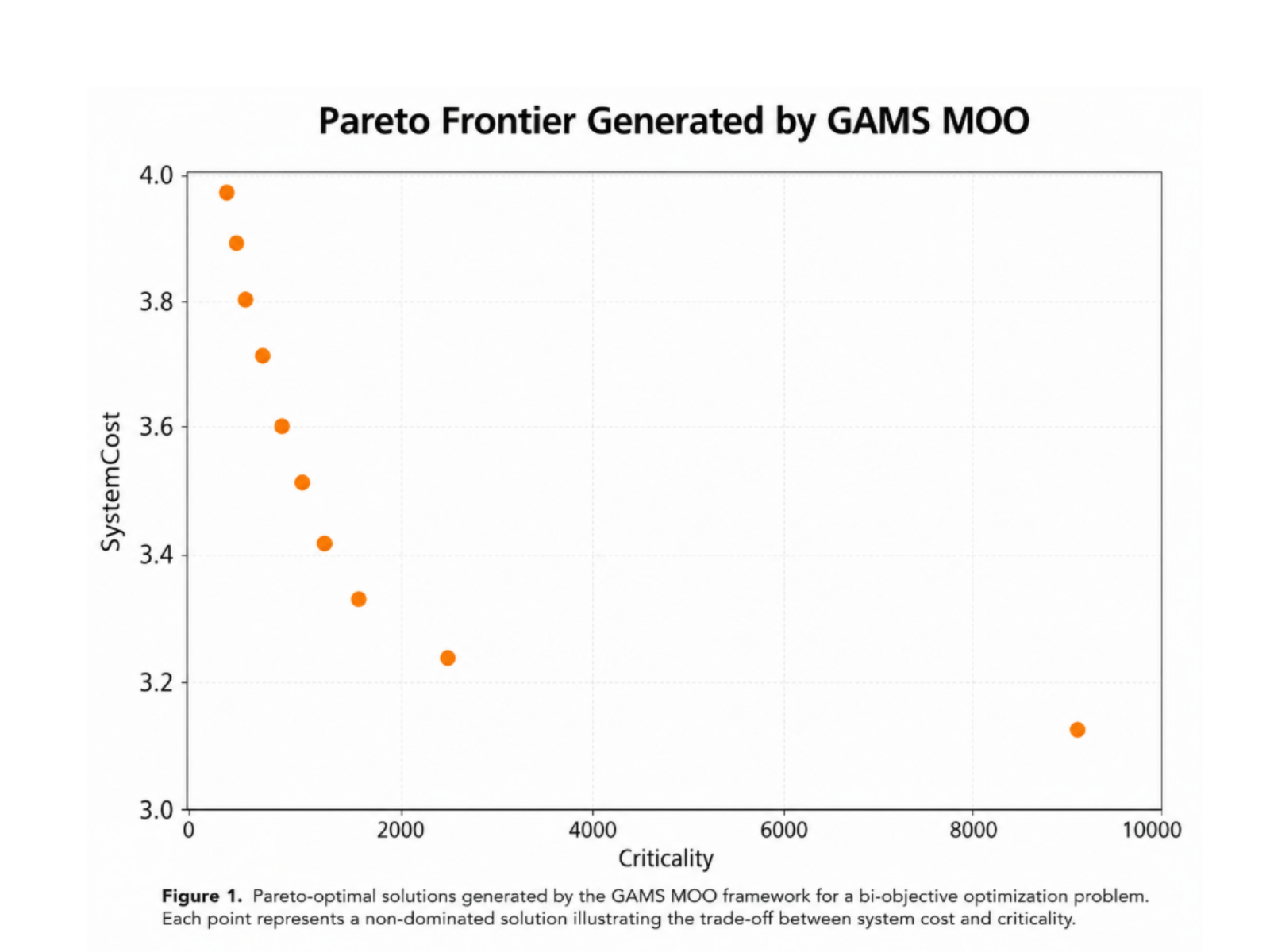
Pareto-optimal solutions generated by the GAMS MOO framework for a bi-objective optimization problem. Each point represents a non-dominated solution illustrating the trade-off between system cost and criticality.
For example, a Pareto front reveals exactly how much energy system cost must increase to achieve a measurable reduction of system criticality - meaning the system’s reliance on critical raw materials like lithium. This mathematical transparency is essential: it ensures that decision-makers are fully informed about potential alternatives, clearly understand the true, quantified cost of their compromises, and can move forward with absolute confidence that their strategic choices align with their broader organizational goals.
Overcoming Modeling Challenges
While modern solvers offer built-in features for basic, hierarchical multi-objective optimization, generating a comprehensive Pareto frontier is a different story. Traditionally, exploring these complex trade-offs meant building custom implementations from scratch. Modelers had to write complex, model-specific code, manually program loops, and manage the extraction of Pareto solutions themselves. Beyond the initial setup, these custom scripts are a massive headache to maintain and expand. If a modeler decides they want to try a different solving algorithm, they cannot just swap out a single line of code—they potentially have to rewrite the entire workflow.
The need for a better solution became especially apparent during the RESUME research project. The project sought to transition the large-scale REMix energy system model from pure cost optimization to balancing resilient and geopolitically secure energy systems across Europe. Because generating a Pareto frontier requires solving many large-scale instances of REMix, solve time quickly became a critical bottleneck. This distinct challenge drove the development of a highly performant, general-purpose MOO tool that now lives natively within the GAMS modeling environment.
The GAMS MOO Framework: Accessible, Performant, and Stable
The GAMS MOO framework eliminates the overhead of custom implementations by providing a ready-to-use, standardized pipeline, freeing you to focus on analyzing trade-offs rather than debugging and maintaining algorithm implementations.
Fully incorporated into the standard GAMS distribution, the tool offers a low barrier to entry through a simple interface, sample models, and comprehensive documentation . Rather than relying on clunky workarounds, the framework is explicitly engineered to deliver on several critical fronts:
- Accessible and Standardized: Models can now be expanded with minimal programming effort, which significantly lowers the barrier for multi-objective optimization.
- Performance at Scale: To drastically reduce solution times for large-scale models, model generation was heavily optimized using the GAMSModelInstance class. The framework also leverages parallel computing where algorithmically beneficial (e.g., the Augmented Epsilon Constraint algorithm), providing out-of-the-box parallel execution for shared-memory architectures and supporting distributed-memory (HPC) environments with some additional configuration.
- Computational Stability: The tool has been rigorously tested and adapted for numerically challenging models - like those typically found in energy modeling - ensuring robust convergence.
The Algorithm Portfolio
The framework currently includes several a posteriori methods to generate Pareto-optimal solutions, allowing users to switch between them effortlessly by changing a single line of code. The portfolio currently includes Random Weighting, Augmented Epsilon Constraint, and Sandwiching.
- Random Weighting: This method optimizes the weighted sum of the objective functions. It generates Pareto points by randomly varying the weights. This straightforward approach serves as an easy-to-use baseline for initial explorations of the Pareto front. Check out more details at Multi-Objective Optimization (moo) > RandomWeighting .
- Augmented Epsilon Constraint: This algorithm optimizes one objective while constraining the others, iterating through predefined grid points to find exact Pareto solutions. It is versatile, supporting LP, MIP, as well as corresponding Non-Linear cases. It is also highly suitable for parallelization and avoids redundant calculations by exploiting information from slack variables to skip infeasible solutions. Check out more details at Multi-Objective Optimization (moo) > EpsConstraint .
- Sandwiching: This method approximates the Pareto front by “sandwiching” it between an inner and an outer approximation. It is highly efficient because it sequentially generates Pareto points in regions where the approximation error is the largest. It provides an explicit accuracy measure, allowing the algorithm to stop once a predefined approximation gap is reached. This method is restricted to LP models and cannot be parallelized. Check out more details at Multi-Objective Optimization (moo) > Sandwiching .
Mini-Tutorial: Upgrading Your GAMS Code
Transitioning your code from a single objective to multiple objectives is a seamless process.

Step 1: Start with Your Existing GAMS Model
Before diving into trade-offs, let’s look at the baseline. If you are already managing multiple objectives, you might be using a simple hierarchical optimization. In this approach, you solve for one objective, constrain it, and then solve for the next. Your code likely looks something like this:
*[...] Sets and Parameters
Variable cost       'Variable capturing System Cost';
Variable co2        'Variable capturing CO2';
Variable endogenous 'Variable capturing Endogenous Use';
*[...] Other Variables and Equations
Model modelname /all/;

* Simple hierarchical optimization
solve modelname use LP min cost;
cost.up = cost.l; solve modelname use LP min co2;
co2.up = co2.l;   solve modelname use LP max endogenous;
Step 2 & 3: Define Multiple Objectives & Call the MOO Framework
To transition from manual hierarchical solves to a workflow using the MOO framework, you only need to make a few straightforward modifications to your existing model.
First, define a set for your objectives and a parameter specifying their optimization directions (-1 for minimizing, +1 for maximizing). Next, create a one-dimensional objective variable (Z) and link your existing variables to it using explicit mapping equations. Finally, define the sets and parameters for your Pareto points, and replace your manual solve statements with the $libInclude moo command to trigger the framework:
*[...] Sets and Parameters
Variable cost       'Variable capturing System Cost';
Variable co2        'Variable capturing CO2';
Variable endogenous 'Variable capturing Endogenous Use';
*[...] Other Variables and Equations

Set objectives 'Objective Functions';
Parameter direction(objectives<) 'Direction of the Objective Functions -1 for min, +1 for max'
  / cost -1, co2 -1, endogenous +1 /
Variable Z(objectives) 'Objective Function Variables';
Equation defCost;       defCost..       Z('cost')       =e= cost;
Equation defCO2;        defCO2..        Z('co2')        =e= co2;
Equation defEndogenous; defEndogenous.. Z('endogenous') =e= endogenous;

Model modelname /all/;

Set points 'Pareto Points' / point1*point100 /;
Parameter pareto_obj(points, objectives) 'Objective Values of Pareto Points';

$libInclude moo EpsConstraint modelname LP objectives direction Z points pareto_obj
Step 4: Select Your Algorithm and Settings
In the example above, the tool utilizes the EpsConstraint method to solve the model, automatically outputting the generated Pareto points directly into your pareto_obj parameter.
Want to capture more than just the objective values? You can easily instruct the tool to export the full solution for each Pareto point by adding the -savepoint=1 option.
If you want to try a different algorithm, simply swap out EpsConstraint in your include statement for Sandwiching or RandomWeighting, and the framework handles the rest.
Full code examples can be found here .
Step 5 & 6: Generate Pareto Frontier & Analyze Trade-offs
Once your setup is complete, all that is left is to run your model exactly as you normally would. The MOO framework takes over from there, automatically generating the Pareto frontier based on your configurations.
When it comes to analyzing those trade-offs, you have a couple of options for visualizing your results:
- Quick Built-in Plots: If you are working with two or three objectives, the MOO framework includes a basic, out-of-the-box plotting feature. Simply add the
-plot=1option to your run, and GAMS will generate a quick-glance visualization of your frontier. It is a great way to immediately verify your results without any extra coding. - Custom Advanced Plotting: Need something more robust? Because the built-in plots are relatively simple, you might want to create your own. GAMS makes it incredibly straightforward to export your frontier data. From there, you can easily pull the data into your favorite external tools—like Python (using libraries such as Matplotlib or Seaborn)—to write custom scripts, dive deep into the trade-offs, and generate highly customized, publication-ready charts.
What’s Next
By standardizing the process, the GAMS MOO framework dramatically lowers the barrier to entry for analyzing complex trade-offs. While it was specifically built and proven at scale for the large-scale LPs found in energy modeling, its generic nature means it has wide applicability to modeling problems far beyond energy system analysis.
Looking Ahead: The framework is fully extendable. We are actively working on adding more algorithms to the portfolio to expand your multi-objective toolkit. Furthermore, we are planning to bring multi-objective optimization directly into GAMSPy, ensuring that GAMS speed and Python ease work together seamlessly for your data and analytics pipelines.
Check out the MOO tool in your next project, explore its documentation , and let us know what you think! We are eager to hear your feedback, feature requests, and algorithm wishes as we continue expanding and refining the framework.
The RESUME project was funded by the German Federal Ministry of Economic Affairs and Energy. Duration: 2022–2026. Funding code: 03EI1048C.