
Area: Climate Modeling, Policy
Problem class: NLP
Technologies: GAMS, CONOPT, GAMS Grid Facility
How large-scale optimization and modular model development support long-term climate scenario analysis
WITCH (World Induced Technical Change Hybrid) is one of the world’s leading Integrated Assessment Models, developed by researchers at the RFF-CMCC European Institute on Economics and the Environment (EIEE). Over nearly two decades, it has become a long-running platform for climate mitigation and scenario analysis, with its scenarios assessed by the IPCC and featured in both the AR5 and AR6 Assessment Reports. Researchers and policymakers rely on frameworks like WITCH to explore pathways for limiting warming - connecting economic growth, energy systems, and climate dynamics across decades.
Throughout that evolution, GAMS and the CONOPT solver have supported WITCH’s implementation through large-scale optimization and modular model development. This case study looks inside WITCH: how the model is structured, the optimization challenges it tackles, and how GAMS supports its implementation.
WITCH is a hybrid Integrated Assessment Model: it combines a top-down macroeconomic optimal growth framework with a bottom-up engineering representation of the energy sector, integrated so that energy investments and macroeconomic decisions are optimized together. That hybrid design is what makes the model valuable and what makes it computationally demanding.
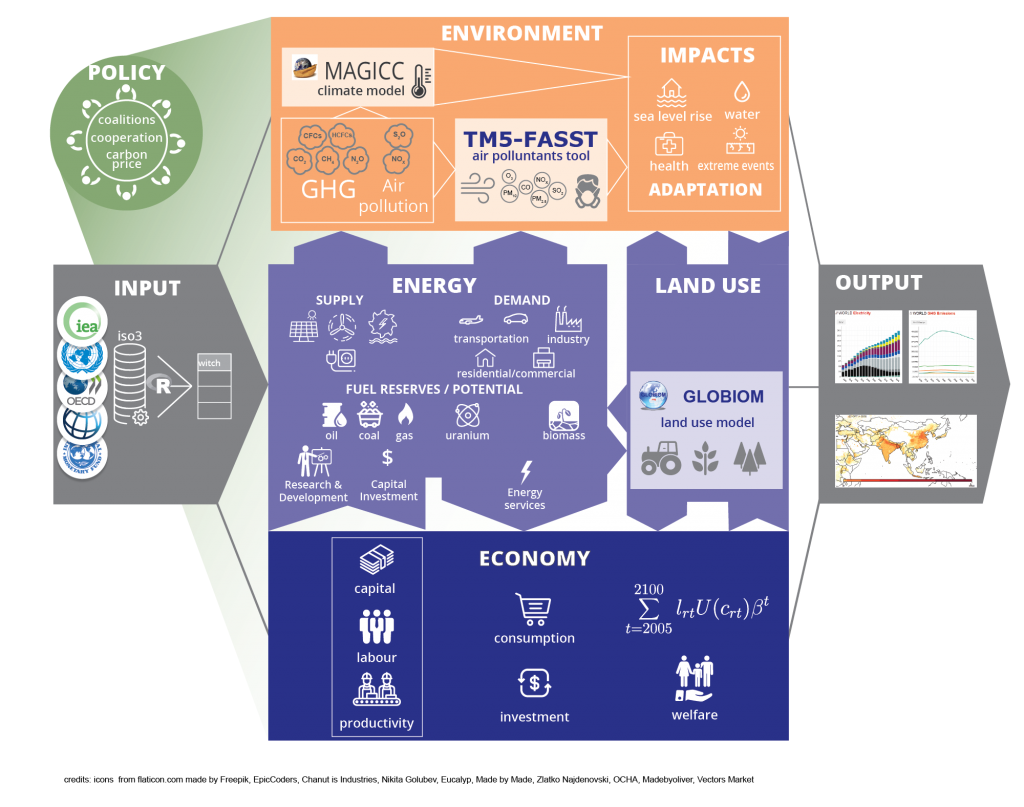
The model represents interactions across 17 macro-regions over a century-scale planning horizon. Rather than assuming a single global decision maker, regions act strategically - creating a large-scale nonlinear optimization problem with long planning horizons, evolving technology assumptions, repeated scenario execution, and complex interdependencies across economic and energy systems. This combination of scale and complexity is what makes WITCH both scientifically valuable and computationally demanding.
WITCH also connects to complementary frameworks including:
That complexity is central to WITCH’s value as a research framework and drives the need for scalable, maintainable model implementation.
WITCH was first implemented in GAMS in 2006 and continues to use it as its core modeling environment today. Its development has closely mirrored the broader evolution of climate mitigation scenarios, which Tavoni et al. (2026) trace across three distinct phases: a formative age focused on concentration stabilization, an age of increasing ambition in which 2°C targets and carbon removal entered the picture, and an age of reckoning in which 1.5°C goals and temperature overshoot became unavoidable features of scenario design. Across each of these phases, WITCH has expanded its regional representation, incorporated new technologies, and adapted to new scenario requirements while maintaining continuity in its underlying model structure. That continuity reflects a broader challenge in scientific software: models must not only solve difficult optimization problems, they must remain understandable and maintainable across changing requirements and contributors.
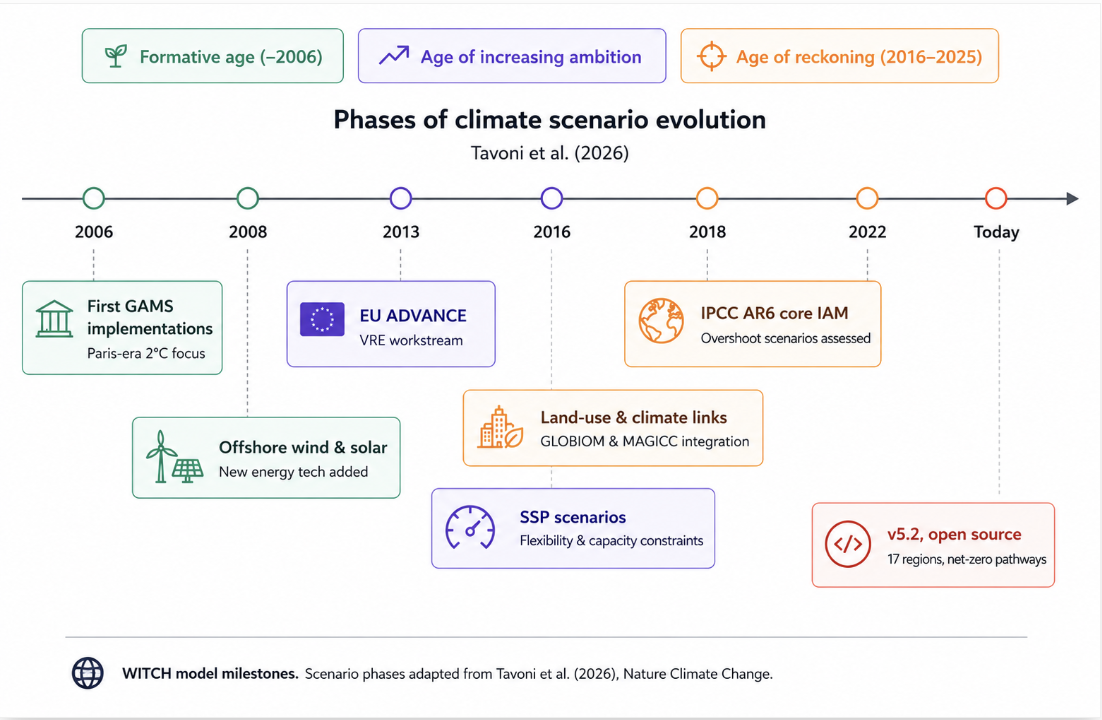
Central to this continuity is the stability of the GAMS language and engine itself: model code written in 2006 continues to run reliably today, without requiring rewrites as the framework evolves. Building on this foundation, GAMS has supported WITCH’s long-term development on three distinct fronts: by providing robust large-scale optimization solvers, enabling a maintainable and readable modular organization, and offering a suite of performant APIs and data-handling tools.
WITCH brings together long planning horizons, regional interactions, evolving technology assumptions, and repeated scenario execution within a large-scale nonlinear framework. For models operating at this scale, computational performance is paramount.
GAMS is suited for this demanding environment due to two key factors:
As mathematical models grow, maintainability becomes as important as performance. Unlike conventional software engineering, modularity in optimization models is complicated by the tight coupling between variables, equations, objectives, and data structures. In practice, even relatively small changes, such as introducing a scenario constraint or extending technology representation, can require coordinated updates across multiple parts of the model. In collaborative environments, this creates two challenges: contributors need a deep understanding of the overall structure to make changes safely, and version management becomes increasingly difficult as complexity grows.
GAMS supports modular organisation of optimization models by separating compilation from execution. WITCH makes extensive use of this approach, allowing different parts of the framework to be modeled independently as modules. Modelers can relax assumptions, introduce constraints, modify regional structures, and contribute across different model components without redesigning the overall structure of the model. This provides added flexibility, reduces bottlenecks, and speeds up development as new features are added.
Like any large-scale modeling framework, WITCH sits within a broader workflow, from raw data preparation through to results analysis. This pipeline involves preprocessing, scenario orchestration, and downstream analysis around the core optimization model.
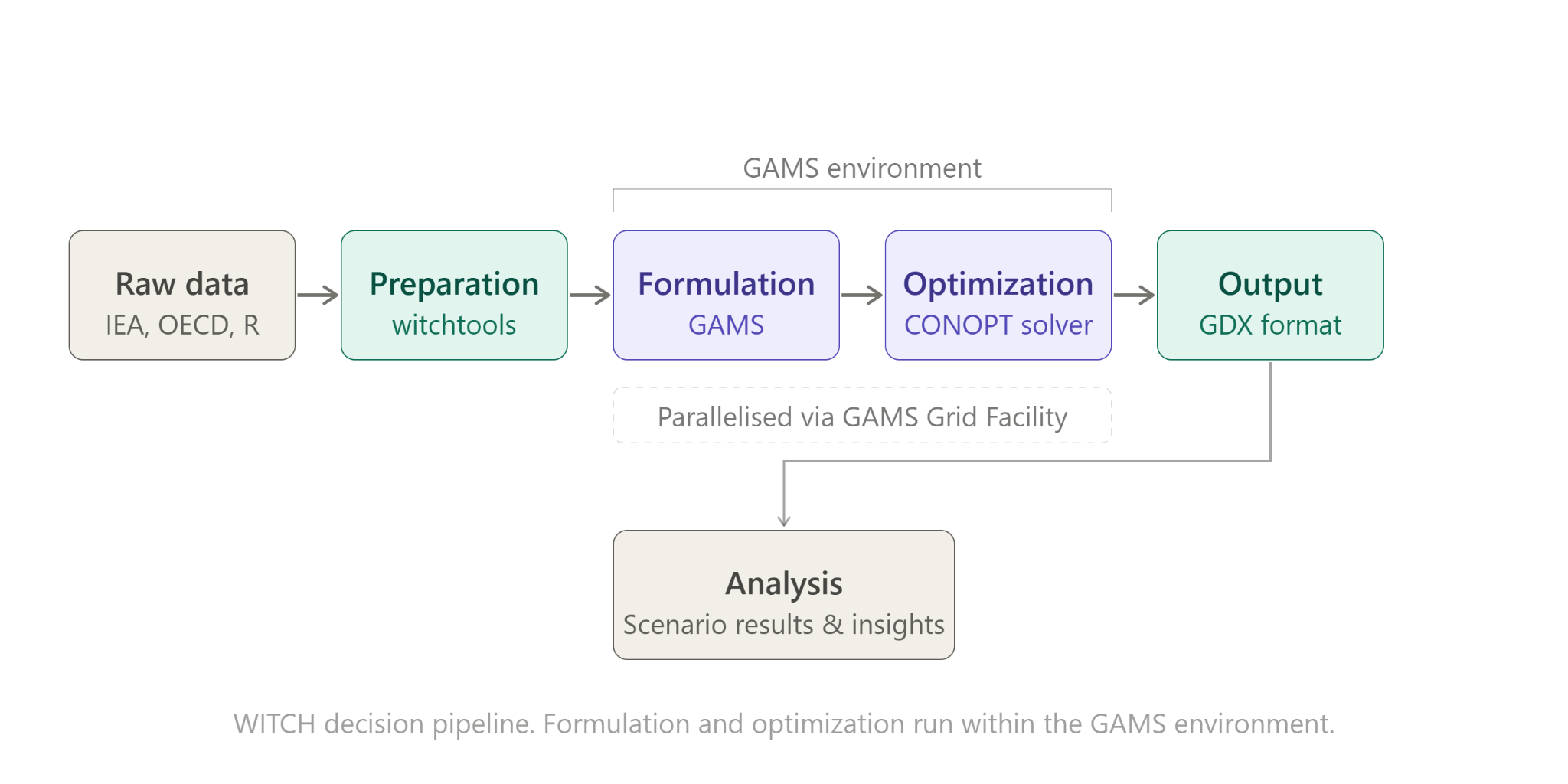
GAMS inherently supports this pipeline through its abstract modeling approach, which strictly separates model formulation from both input data and solver execution. Because the core logic is isolated from data and solver choice, the model can be assessed independently in a broader decision pipeline. This keeps the GAMS code closely aligned with the mathematical formulation, making it easier to maintain. Furthermore, it ensures that any improvements to GAMS tools (like gamstransfer) or solvers translate directly into performance gains without requiring developers to rewrite parts of the model.
WITCH is a useful example of what it means to build scientific infrastructure that lasts. The challenge in climate policy modelling is rarely any single equation - it is maintaining a framework that remains economically rigorous, technically detailed, computationally tractable, and maintainable across changing research questions and generations of contributors.
As Tavoni et al. (2026) show, climate scenarios have shifted dramatically over the past three decades, from concentration stabilization targets to the unavoidable reality of temperature overshoot. WITCH has evolved through each of these phases, contributing scenarios that are now part of the IPCC AR5 and AR6 Assessment Reports and informing how researchers and policymakers understand the costs, trade-offs, and pathways of long-term climate action. That kind of sustained scientific relevance is only possible when the underlying modeling infrastructure can grow with the research questions - which is precisely what GAMS and CONOPT have enabled.
Learn more about the WITCH framework and related modelling ecosystem:
Building a large-scale optimization model or maintaining a long-lived scientific codebase?
Get in touch with the GAMS team to discuss how GAMS supports scalable optimization workflows and collaborative model development.
Tavoni, M., Bauer, N., Drouet, L., Fujimori, S., Paltsev, S., Pirani, A., Riahi, K., Rogelj, J., Schaeffer, R., van Vuuren, D., Weitzel, M. & Kriegler, E. (2026). Implications of overshoot for climate mitigation strategies. Nature Climate Change, 16, 261-272. https://doi.org/10.1038/s41558-026-02563-7
We thank Dr. Laurent Drouet (CMCC Foundation - Euro-Mediterranean Center on Climate Change and NOVA University Lisbon) for his collaboration and expert input in the development of this case study.