
"The new GAMS MIRO interface for METRO significantly improves the user experience. It streamlines workflows and makes working with the METRO model more intuitive and accessible."
Area: Economics Problem class: MCP Technologies: GAMS, MIRO
The OECD’s METRO trade model , written in GAMS, is a sophisticated tool for understanding the intricate web of global commerce. As a large-scale Computable General Equilibrium (CGE) framework, it plays a critical role in shaping the international policy landscape.
By modeling the interactions between producers, consumers, and governments across 145 individual countries, 18 regions, and 65 sectors, METRO allows policymakers to simulate how changes, whether from deliberate policy interventions (trade policy, technology investment), external shocks (Brexit, supply chain disruptions), or both, impact prices, production, and employment. Put simply, the model has the ability to turn abstract policy proposals into concrete economic predictions, and answer the question: “How do changes in one part of the world ripple through global supply chains to affect outcomes elsewhere?”
METRO is an incredibly powerful decision tool, but even the most advanced models face barriers if they are difficult to access. To transition METRO into a modern, platform-independent application, the OECD partnered with GAMS and Elevate Economics . By combining technical optimization expertise and deep economic domain knowledge, the team successfully transformed this complex framework into an accessible, user-friendly tool powered by GAMS MIRO.
For decades, the METRO model relied on an interface that served it well. But in recent years, that technical environment has become a limitation. The model was locked into a Windows-only interface, which presented installation and compatibility hurdles that complicated rollout for international teams. What’s more, the GAMS model itself relied on GDXXRW, a powerful but Windows-specific tool for Excel I/O. Combined with OS-specific file paths and deprecated utilities, the result was a model that could not be easily run on other platforms or modern cloud environments.
Beyond the operating system, another challenge was the multi-stage nature of CGE modeling. While most models in MIRO use a stateless run, where inputs lead directly to a single model solve, METRO is not a single-shot simulation tool. It is a structured economic pipeline that includes aggregation, calibration (baseline construction), policy simulation and analysis, where each step produces artifacts that feed the next. In practice, CGE modelers often need to revisit individual stages - recalibrating elasticities, modifying closures, or updating aggregation schemes - without restarting the entire process. This means one would need to support branching and selective re-runs rather than rebuilding the entire chain from scratch.
On top of this, the OECD community is used to preparing scenarios in complex spreadsheets, and they wanted to maintain this practice without major changes to their templates or conventions - meaning that any migration had to preserve the existing user workflow.
The collaboration between GAMS, Elevate Economics and the OECD delivered a platform-independent solution that perfectly balances backend complexity with frontend simplicity: A MIRO application for the METRO model.
The first step was to break the Windows lock-in. For this, the team decided to replace GDXXRW with GAMS Connect , a framework that allows one to integrate data from various sources smoothly. This modernized the Excel I/O process, delivering the same sophisticated data handling capabilities, while enabling METRO to run reliably across different operating systems. Alongside it, the team normalized file paths and replaced outdated utilities so the model is now cloud-ready and accessible on any device.
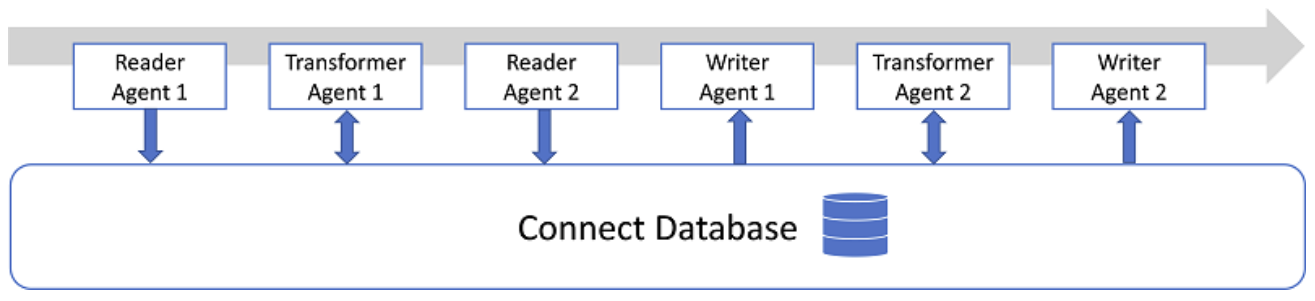
To bridge the gap between METRO’s modular nature and the MIRO interface, the team created a custom GAMS wrapper to mediate between the codebase and the application. This layer acts as an orchestrator that coordinates the individual model stages, routes user inputs to the appropriate step, and feeds intermediate results back into MIRO for subsequent tasks. This approach meant the original METRO codebase remained largely unchanged, preserving decades of investment in the model logic.
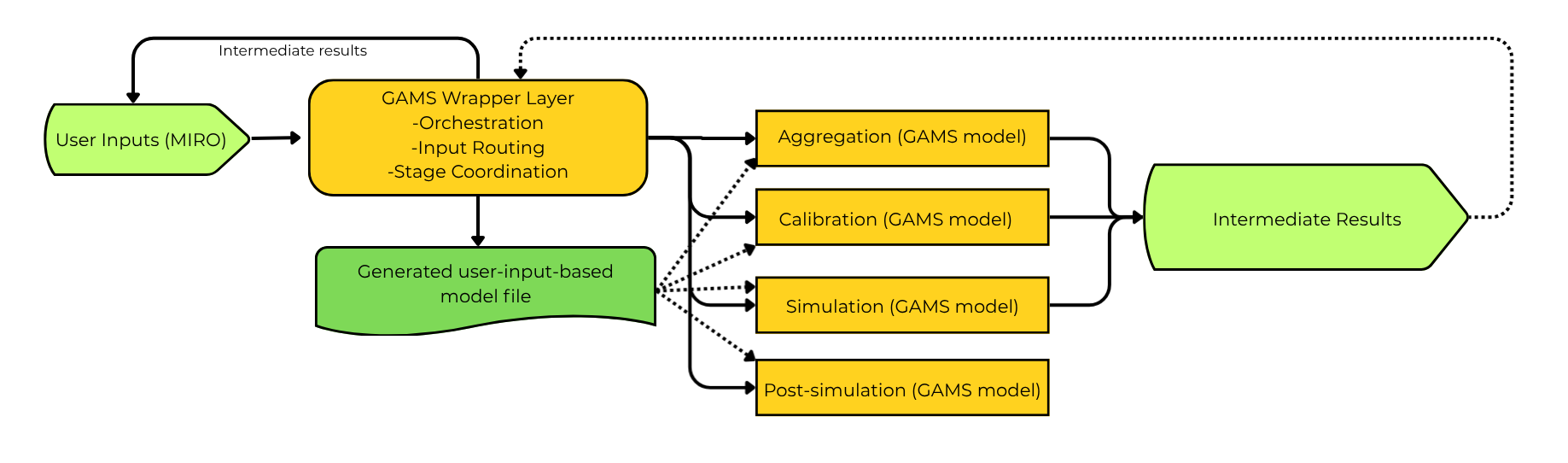
For the CGE practitioner, this means the “Initial State” (calibration to the GTAP database) is preserved as a distinct, verifiable step within the MIRO workflow, ensuring that simulation shocks are always measured against a consistent benchmark. Crucially, while the MIRO interface streamlines the user experience, the METRO model’s core GAMS equations remain fully transparent and extensible for expert users, ensuring the model remains a “white-box” scientific instrument.
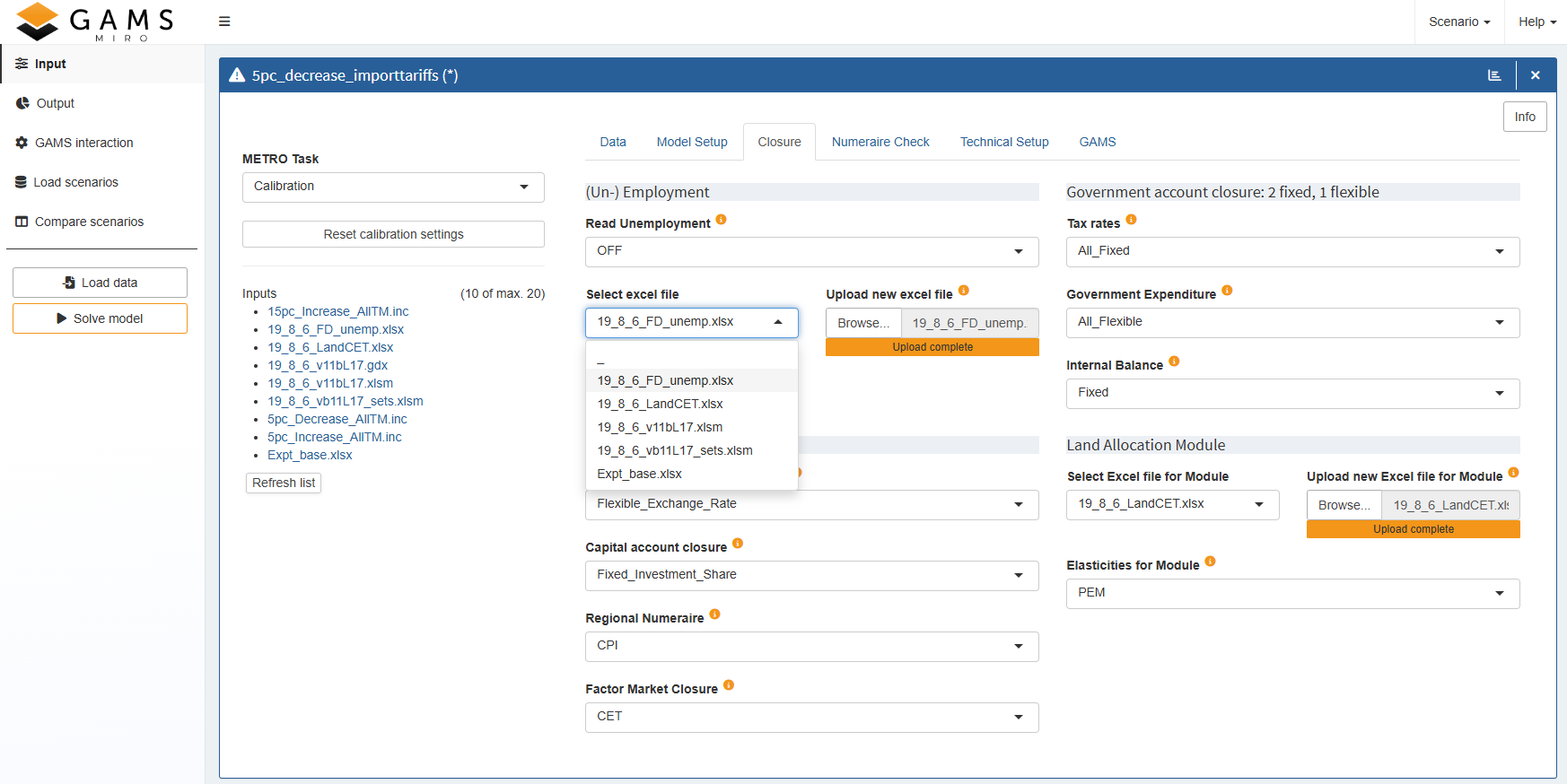
The new application’s input interface organizes the complex model’s sequence into a single, stepwise workflow. Here, users can configure model-wide settings, such as module selection, closure rules, and elasticity sources, all directly in the app; and for detailed data entry the familiar spreadsheet-based workflow is preserved. Users can upload their existing spreadsheets via the MIRO interface, which passes them to the wrapper for execution and removes file-system friction while keeping data practices intact.
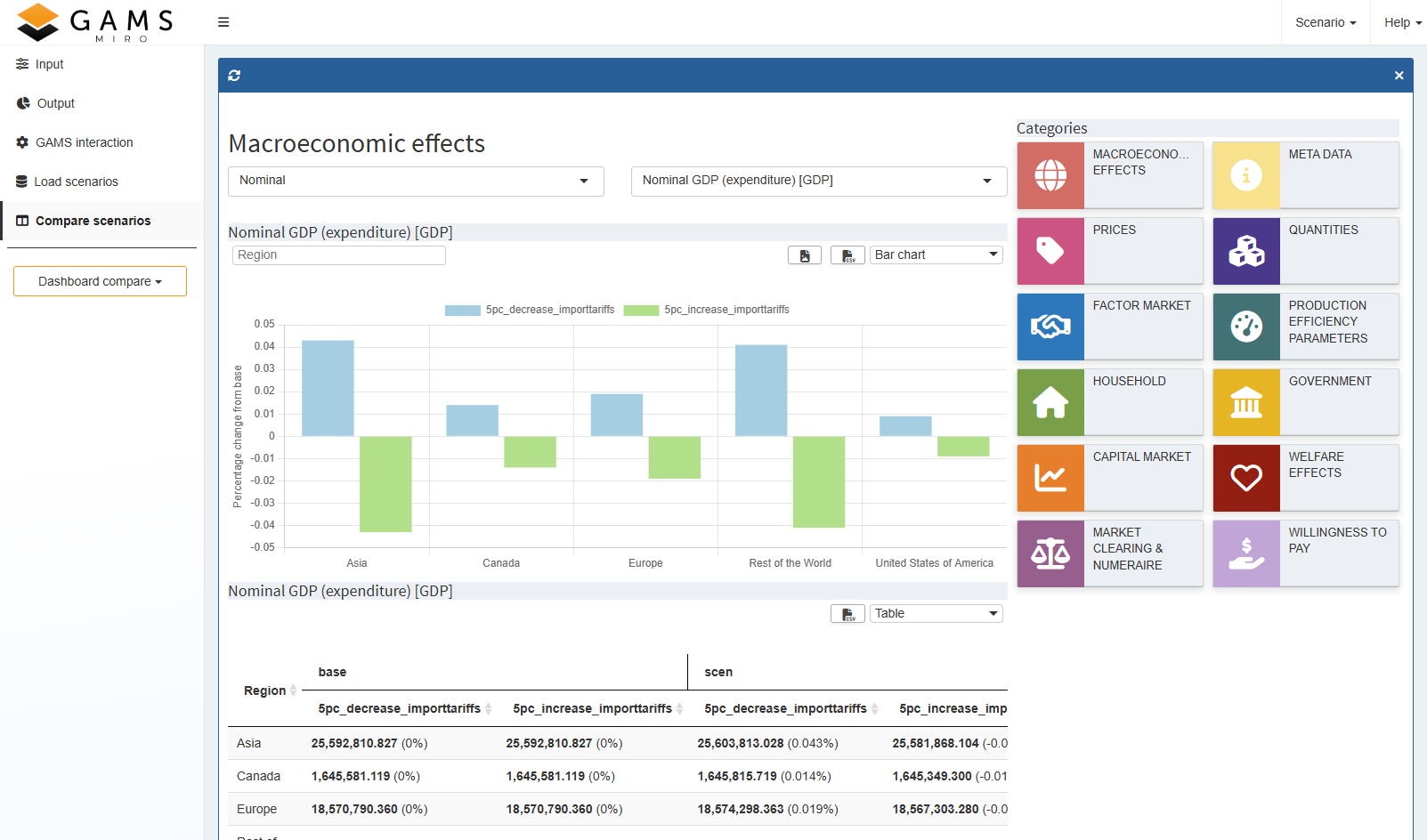
Once a simulation is complete, the results are delivered through an interactive dashboard designed for economic analysis. Instead of wading through raw data, modelers can immediately assess key indicators like trade diversion effects, terms-of-trade changes, welfare impacts, and sectoral reallocation. The interface allows for instantaneous what-if analysis. Curated views with hundreds of predefined configurations make it possible to compare simulation results against baseline calibrations and to overlay results from multiple policy scenarios, such as varying levels of tariffs, in order to visualize diverging impacts on GDP, sectoral output, and supply chain propagation.
For deeper analysis, integrated pivot tables provide full access to the underlying multi-dimensional output. Modelers can filter and aggregate by region, sector, commodity, or factor, and save custom views to examine specific segments of the global value chain. This ensures that while the dashboard provides the big picture, the full granularity of the CGE results remains entirely accessible for rigorous verification.
For CGE modelers, modernization is not merely a technical upgrade, it directly affects how scenarios are designed, how results are validated, and how models are shared. By transforming METRO into a MIRO-based application, the project:
Reduces friction in managing dozens of tariff scenarios and comparing elasticity assumptions.
Improves reproducibility by eliminating system dependencies.
Maintains calibration pipelines and spreadsheet-based workflows.
Allows modelers to focus on economic logic rather than debugging file paths.
The OECD METRO project illustrates how GAMS MIRO can bridge the gap between complex economic models and accessible, user-friendly applications. By modernizing the technical infrastructure without disrupting the underlying logic, the collaboration between GAMS, Elevate Economics, and the OECD ensures that this flagship trade model is ready to meet the needs of a global, policy-focused audience.
Maria Seara e Pereira, Trade Modeler at the OECD:
“The new GAMS MIRO interface for METRO significantly improves the user experience. It streamlines workflows and makes working with the METRO model more intuitive and accessible. The platform-independent setup eliminates system-specific constraints, which means no more environment-related issues or troubleshooting headaches across different systems. This saves time and creates a more robust, reliable solution. The result is a platform that’s easier to adopt and reaches a broader range of users.”
In summary, the project proves that highly complex, multi-stage models can be transformed into modern tools that maintain accuracy and flexibility while eliminating the barriers of the past. With a robust and scalable foundation now in place, the OECD is well-equipped to provide the insights needed to navigate the evolving landscape of global trade.
If you are interested in seeing this in action, we invite you to explore a similar CGE model application directly in our GAMS MIRO gallery. This app has a slightly different approach, as it only includes the simulation step, and “shocks” are determined by using slider widgets (instead of via Excel files); but it’s a great opportunity to interact with the interface, run scenarios, and visualize global trade data directly in your browser.